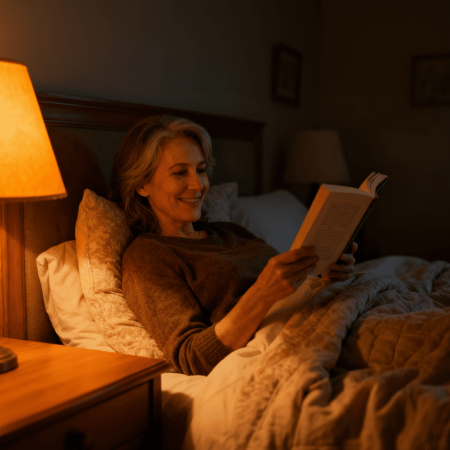
Let’s be honest: menopause helps us lose sleep all on its own. Between the sudden need to throw off the duvet because you’re melting, and the 3 AM brain fog that insists you remember an embarrassing thing you did in 1998, sleep is already a bit of a battlefield.
But here’s the thing—we might be sabotaging the little precious rest we do get. Yes, I’m looking at you, scrolling through social media or checking emails right before your head hits the pillow. We all do it. It feels like “winding down,” but biologically, it’s doing the exact opposite.
If you are navigating menopause, your body is already going through a massive hormonal renovation. Adding a digital flood of blue light to the mix is like inviting a brass band into a library. Let’s talk about why this happens and, more importantly, how we can fix it naturally (and painlessly).
The Blue Light Problem (It’s Not Just Hype)
Our bodies are brilliant, ancient machines designed to sync with the sun. When the sun goes down, our brains are supposed to release melatonin, the hormone that whispers, “Hey, it’s time to sleep now.”
The problem with our phones, tablets, and TVs is that they emit a specific frequency of blue light that mimics the midday sun. When you stare at a screen at 10 PM, your brain thinks it’s noon. It effectively slams the brakes on melatonin production, leaving you wired, alert, and staring at the ceiling.
For women in menopause, this is a double whammy. We are already dealing with fluctuations in hormones that can disrupt sleep architecture. Recent research has shown that the impact of light intensity on our melatonin levels is significant, directly affecting how long it takes us to fall asleep (sleep latency) and how alert we feel when we should be drowsy.
Why Menopause Makes You More Sensitive
During perimenopause and postmenopause, our natural sleep architecture changes. Studies suggest that melatonin secretion patterns can shift during this transition. If your baseline melatonin is already dancing to a new, unpredictable rhythm, blasting it with blue light is the last thing you need.
Prioritizing a digital detox isn’t just about “being disciplined”—it’s a biological necessity to give your changing body a fighting chance at restoration.
Natural Techniques for a Digital Detox
You don’t have to throw your phone into the ocean (though the temptation is real). Here are some practical, natural ways to reclaim your night:
1. The “Sunset” Rule
Aim to stop using screens one to two hours before your target bedtime. If the sun has clocked out, your phone should too. Use this time for activities that signal safety and relaxation to your nervous system:
- Reading a physical book (remember those?).
- Gentle stretching or restorative yoga.
- Listening to an audiobook or podcast (audio is fine, just keep the screen dark!).
2. Embrace the “Red”
If you absolutely must use a device, or if you have lights on in the house, switch to red or amber wavelengths.
- Amber glasses: These block blue light from entering your eyes. You might look a bit like a scientist from a 70s sci-fi movie, but your pineal gland will thank you.
- Red night lights: Swap your bedside bulb for a red or amber one. It provides enough light to see without triggering the “wake up” signal in your brain.
3. The “Bedroom Sanctuary” Policy
Make your bedroom a device-free zone. Buy an old-school alarm clock (the kind that just tells time and doesn’t notify you about emails). Charging your phone in the kitchen prevents that late-night “I’ll just check one thing” loop that turns into an hour of doom-scrolling.
4. Grayscale Mode
If you can’t banish the phone entirely, switch your screen to “Grayscale” (black and white) in the accessibility settings. It makes Instagram and Facebook look incredibly boring, which naturally reduces the dopamine hit that keeps you scrolling.
A Final Welcoming Thought
Navigating menopause is a journey of listening to your body. It’s asking for rest, for gentleness, and for a return to natural rhythms. By dimming the lights and putting the screens away, you aren’t missing out on the world online; you are tuning back into the world within you. You deserve that rest.
References
- Blue light and sleep latency, I. Schöllhorn, O. Stefani, R. J. Lucas, M. Spitschan, Melanopic irradiance defines the impact of evening display light on sleep latency, melatonin and alertness, 2023.
- Menopause and melatonin, H. M. Kravitz, H. Joffe, Nighttime melatonin secretion and sleep architecture: different associations in perimenopausal and postmenopausal women, 2021.