Let’s be honest: “Bacteria” is usually a word we associate with cleaning products or that questionable Tupperware container found in the back of the fridge. But when you hit perimenopause and menopause, bacteria—specifically the good kind—become your new best friends.
If you’ve been feeling like your digestion has gone on strike or your mood is swinging faster than a pendulum, the answer might just be sitting in a jar of bubbly, fermented goodness.
Here is why adding a little “controlled rot” (okay, let’s call it fermentation) to your diet might be the natural hack you’ve been looking for.
The Menopause-Microbiome Connection
You might have heard of the microbiome, but have you met the Estrobolome? No, it’s not a new dance move. It is a specific collection of bacteria in your gut capable of metabolizing and modulating the body’s circulating estrogen.
During menopause, when our ovaries decide to retire, we need every bit of help we can get to keep our hormones balanced. If your gut is unhappy, your estrobolome can’t do its job, leading to hormonal recycling issues that can exacerbate hot flashes and weight gain.
Why Fermented Foods are the VIPs
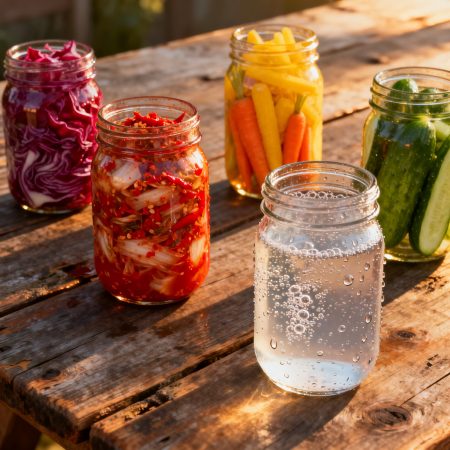
Fermented foods have been through a process of lactofermentation in which natural bacteria feed on the sugar and starch in the food, creating lactic acid. This process preserves the food and creates beneficial enzymes, b-vitamins, Omega-3 fatty acids, and various strains of probiotics.
Here is what they can do for the menopausal body:
- They Tame the Bloat: As stomach acid tends to decrease with age, digestion gets sluggish. The enzymes in fermented foods act like little traffic controllers, keeping things moving.
- Mood Rescue: Did you know about 90% of your serotonin is made in your gut? A happy gut often equals a happier, less anxious you.
- Bone Protection: Fermented foods are often rich in Vitamin K2, which is essential for directing calcium into your bones and keeping it out of your arteries.
The Water Kefir vs. Milk Kefir Showdown
Now, let’s talk about Kefir. Usually, when people hear “kefir,” they think of a thick, yogurt-like drink. That’s Milk Kefir. While it’s potent, dairy can be a double-edged sword during menopause. It is often inflammatory and, let’s face it, many of us lose the ability to digest lactose gracefully as we age (even most lactose being fermented in the process of making Milk Kefir).
Enter the champion: Water Kefir.
Water kefir is made with water, sugar (don’t worry, the bacteria eat the sugar, not you), and fruit. It is dairy-free, vegan, lighter on the stomach, and arguably more refreshing. It’s like a healthy soda that actually heals your gut instead of destroying it. It is packed with Lactobacillus and Bifidobacterium, specifically tuned to help reduce inflammation without the dairy baggage.
Practical Guide: How to Start (Without Exploding)
If you have never eaten fermented foods, do not sit down and drink a quart of Water Kefir or eat a whole jar of Sauerkraut. Your gut will stage a protest in the form of gas that could clear a room.
The “Low and Slow” Protocol:
- Start Small: 1 tablespoon of sauerkraut liquid or 1 shot glass of water kefir per day.
- Observe: How does your belly feel? Any gurgling is normal (that’s the bad bacteria packing their bags). Pain is not.
- Scale Up: Gradually increase your intake over a few weeks.
A Quick DIY Water Kefir
You can buy it, but making it is cheaper and makes you feel like a kitchen master.
- Get Grains: Buy “Water Kefir Grains” online (they look like translucent crystals).
- The Bath: Dissolve 1/4 cup of sugar in 4 cups of water. Let it cool.
- Ferment: Add the grains. Cover with a breathable cloth. Let it sit on the counter for 24-48 hours.
- Flavor: Strain out the grains (reuse them!). Add fruit juice or ginger to the liquid and bottle it up for another day to get it fizzy.
When to Say “No, Thank You” (Contraindications)
Fermented foods are amazing, but they aren’t for everyone.
- Histamine Intolerance: Fermented foods are high in histamine. If you suffer from unexplained hives, migraines, or if red wine makes you feel terrible, go very, very easy. Histamine overload can sometimes mimic or worsen hot flashes.
- SIBO (Small Intestinal Bacterial Overgrowth): If you have SIBO, throwing more bacteria (even good ones) into the party can add fuel to the fire. Clear the SIBO with a professional first, then repopulate.
- Immune Compromise: If your immune system is severely compromised, consult your doctor before introducing live bacterial cultures.
Final Thoughts
Your gut is the control center for your health during this transition. Treating it to some bubbly water kefir or a forkful of kimchi is a simple, natural way to tell your body, “I got you.” Start slow, listen to your belly, and enjoy the bubbles.
References
- Estrobolome & Hormones: Baker, J.M., Al-Nakkash, L., & Herbst-Kralovetz, M.M., “Estrogen-gut microbiome axis: Physiological and clinical implications”, 2017.
- Bone Health: Knapen, M.H.J., et al., “Three-year low-dose menaquinone-7 supplementation helps decrease bone loss in healthy postmenopausal women”, 2013.
- Mental Health: Cryan, J.F., & Dinan, T.G., “Mind-altering microorganisms: the impact of the gut microbiota on brain and behaviour”, 2012.
- Histamine Risks: Maintz, L., & Novak, N., “Histamine and histamine intolerance”, 2007.